
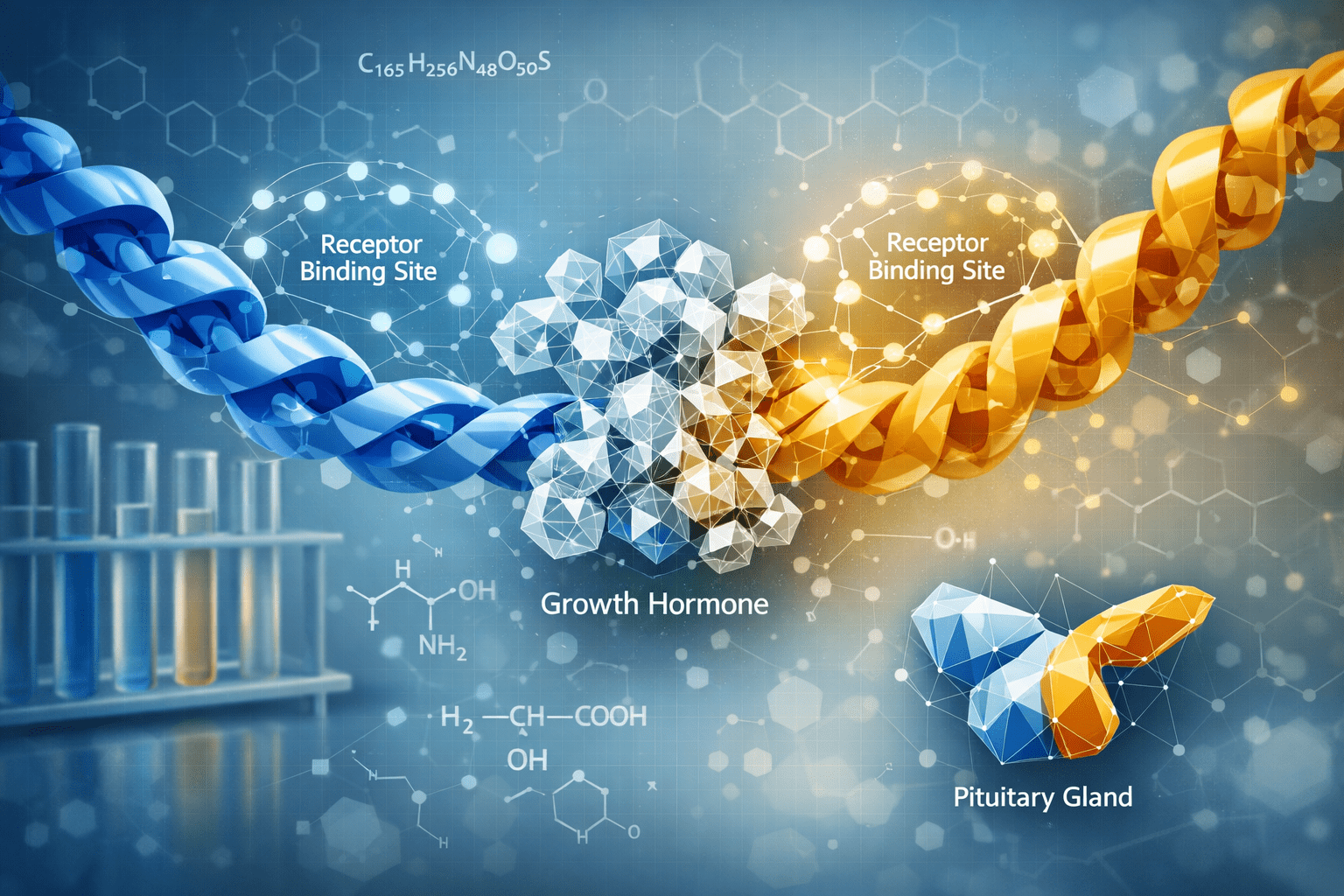
Ipamorelin and CJC 1295 combination represents one of the most extensively researched peptide protocols for growth hormone optimization in 2026. Understanding the synergistic mechanisms between Ipamorelin and CJC 1295 is essential for researchers exploring growth hormone pathways, anabolic signaling, and body composition research. This comprehensive guide explores how Ipamorelin and CJC 1295 work together to amplify endogenous growth hormone production through complementary receptor pathways.
Individual Mechanisms: Understanding Ipamorelin and CJC 1295
Before examining the Ipamorelin and CJC 1295 combination, it’s crucial to understand each peptide’s distinct mechanism:
Ipamorelin:
- Classification: Selective ghrelin receptor agonist (growth hormone secretagogue)
- Mechanism: Binds to ghrelin receptors (GHS-R1a) on pituitary somatotrophs
- Selectivity: Specifically stimulates GH release without affecting cortisol or prolactin
- Half-life: Approximately 2 hours
- Peak GH release: 30-45 minutes post-administration
CJC-1295:
- Classification: Growth hormone-releasing hormone (GHRH) analog
- Mechanism: Binds to GHRH receptors, stimulating GH production and release
- Modification: Drug Affinity Complex (DAC) extends half-life
- Half-life: 6-8 days (with DAC modification)
- Effect duration: Sustained elevation for multiple days
The Synergistic Principle of Ipamorelin and CJC 1295
The Ipamorelin and CJC 1295 combination effectiveness stems from targeting two different pathways in the growth hormone axis:
Ipamorelin works through the ghrelin receptor system, mimicking the “hunger hormone” ghrelin’s GH-releasing effects. CJC-1295 operates through the GHRH receptor system, the body’s primary growth hormone regulation pathway.
When Ipamorelin and CJC 1295 are administered together, these peptides create a dual-stimulation effect:
- CJC-1295 increases the number of somatotroph cells capable of releasing GH
- Ipamorelin triggers the actual release of GH from these primed cells
- The combined effect produces GH pulses significantly larger than either peptide alone
Amplification Effect Research: Ipamorelin and CJC 1295
Studies examining the Ipamorelin and CJC 1295 combination demonstrate GH amplification rather than simple addition. When CJC-1295 primes pituitary cells over several days, subsequent Ipamorelin administration produces GH pulses 200-300% greater than Ipamorelin administered alone.
This amplification in the Ipamorelin and CJC 1295 protocol occurs because:
- CJC-1295 upregulates GH production capacity
- Ipamorelin provides the release signal when GH stores are maximized
- The pulsatile nature preserves natural GH rhythm patterns
- Receptor desensitization is minimized compared to continuous GH elevation
2026 Research Protocol Standards: Ipamorelin and CJC 1295
Standard Combination Protocol:
CJC-1295 (with DAC):
- Dosage: 1-2mg per administration
- Frequency: Once every 5-7 days
- Administration: Subcutaneous injection
- Timing: Any consistent time of day
Ipamorelin:
- Dosage: 200-300mcg per administration
- Frequency: 1-3 times daily
- Administration: Subcutaneous injection
- Timing: Pre-breakfast, post-workout, and/or before bed
The Ipamorelin and CJC 1295 dosing schedule creates consistent pituitary priming (CJC-1295) with strategic GH pulse triggering (Ipamorelin).
Optimal Administration Timing for Ipamorelin and CJC 1295
Research demonstrates superior results with strategic Ipamorelin timing in the Ipamorelin and CJC 1295 protocol:
Morning dose (pre-breakfast):
- Capitalizes on natural cortisol awakening response
- Supports metabolic activation for the day
- Enhances fat oxidation during fasted state
Post-workout dose:
- Maximizes anabolic window
- Enhances protein synthesis
- Supports recovery processes
- Synergizes with exercise-induced GH release
Evening dose (pre-bed):
- Aligns with natural nocturnal GH pulse
- Supports overnight recovery
- Maximizes deep sleep GH secretion
- Considered the most critical administration time
IGF-1 Elevation Patterns with Ipamorelin and CJC 1295
The Ipamorelin and CJC 1295 combination’s effect on IGF-1 levels differs from direct GH administration:
- Week 1-2: Minimal IGF-1 changes as peptides load
- Week 3-4: Gradual IGF-1 elevation (50-100% above baseline)
- Week 5-12: Peak IGF-1 levels maintained
- Post-protocol: Gradual return to baseline over 2-3 weeks
This gradual elevation pattern in Ipamorelin and CJC 1295 protocols produces more sustainable effects compared to exogenous GH’s immediate spike.
Physiological Effects Research: Ipamorelin and CJC 1295
Research protocols monitoring the Ipamorelin and CJC 1295 combination report multiple physiological parameters:
Body Composition:
- Lean mass increases: 2-4kg over 12-16 weeks
- Fat mass reductions: 1-3kg over same period
- Visceral adipose tissue shows preferential reduction
- Subcutaneous fat maintained or slightly reduced
Recovery Markers:
- Enhanced sleep quality metrics in research models
- Reduced inflammation markers (CRP, IL-6)
- Improved collagen synthesis indicators
- Accelerated tissue repair in controlled injury models
Metabolic Parameters:
- Improved insulin sensitivity markers
- Enhanced lipid profiles (reduced LDL, increased HDL)
- Increased resting metabolic rate measurements
- Better glucose disposal rates
Skin and Connective Tissue:
- Increased skin thickness measurements
- Enhanced collagen density in biopsy studies
- Improved hair and nail growth rates
- Better skin elasticity scores
Side Effect Profile: Ipamorelin and CJC 1295
The Ipamorelin and CJC 1295 combination demonstrates favorable tolerability in research:
Common observations:
- Mild water retention (5-10% of subjects)
- Transient injection site reactions
- Increased appetite in some models
- Occasional headaches during initial phase
Rare observations:
- Numbness or tingling (carpal tunnel-like symptoms)
- Joint discomfort (usually resolves within 2-3 weeks)
- Temporary insulin resistance (monitored via HOMA-IR)
CJC-1295 vs CJC-1295 No DAC in Ipamorelin and CJC 1295 Protocols
An important distinction exists in Ipamorelin and CJC 1295 research:
With DAC (Drug Affinity Complex):
- Extended half-life: 6-8 days
- Sustained GH elevation
- Less frequent dosing (weekly)
- Maintains physiological pulse patterns
- Preferred for most Ipamorelin and CJC 1295 protocols
Without DAC (also called Modified GRF 1-29):
- Short half-life: 30 minutes
- Acute GH pulses
- Requires multiple daily doses
- More similar to natural GHRH
- Used when precise timing control needed
For Ipamorelin and CJC 1295 combination protocols, CJC-1295 with DAC is standard due to convenience and sustained priming effects.
Reconstitution and Storage: Ipamorelin and CJC 1295
Ipamorelin:
- Reconstitute with bacteriostatic water
- Typical concentration: 2mg per vial
- Stored reconstituted: 2-8°C for 30 days
- Lyophilized powder: -20°C for 24+ months
- Light-sensitive: store in amber vials or wrapped
CJC-1295:
- Reconstitute with bacteriostatic water
- Typical concentration: 2mg per vial
- Stored reconstituted: 2-8°C for 45 days (more stable than Ipamorelin)
- Lyophilized powder: -20°C for 24+ months
- Less light-sensitive but still protect from direct exposure
Injection Technique for Ipamorelin and CJC 1295 Research
Standardized subcutaneous injection protocols:
- Injection sites: Abdominal area, thighs, or deltoids
- Needle size: 29-31 gauge, 0.5 inch length
- Rotate sites to prevent lipohypertrophy
- Clean injection area with alcohol swab
- Pinch skin and inject at 45-90 degree angle
- Aspirate not necessary for subcutaneous
- Apply gentle pressure post-injection, do not massage
Blood Work Monitoring for Ipamorelin and CJC 1295 Protocols
Research protocols should include baseline and periodic assessments:
Essential markers:
- IGF-1 levels (primary indicator of GH activity)
- Glucose and HbA1c (insulin sensitivity)
- Lipid panel (metabolic effects)
- Liver enzymes (safety monitoring)
- Thyroid panel (TSH, T3, T4)
Optimal testing schedule:
- Baseline: Before starting Ipamorelin and CJC 1295 protocol
- Week 4-6: Initial response assessment
- Week 12: Mid-protocol evaluation
- Week 24: End of protocol
- 4 weeks post: Recovery assessment
Cycling Protocols: Ipamorelin and CJC 1295
Research explores various cycling strategies for Ipamorelin and CJC 1295:
Continuous Protocol:
- Duration: 12-24 weeks
- No breaks during active research period
- Allows assessment of long-term effects
- IGF-1 monitoring every 4-6 weeks
Cycled Protocol:
- 8-12 weeks on, 4-6 weeks off
- Reduces potential receptor desensitization
- Allows natural axis recovery
- Multiple cycles can be studied
5/2 Protocol:
- 5 days on, 2 days off each week
- Mimics workday schedule
- Theoretical receptor sensitivity preservation
- Less research data supporting this approach
Cost Analysis: Ipamorelin and CJC 1295
Typical research budget considerations for 12-week Ipamorelin and CJC 1295 protocol:
Ipamorelin (300mcg daily):
- Daily requirement: 300mcg
- Weekly requirement: 2.1mg
- 12-week total: ~25mg
- Approximate cost: $150-250
CJC-1295 with DAC (2mg weekly):
- Weekly requirement: 2mg
- 12-week total: 24mg
- Approximate cost: $200-350
Total 12-week Ipamorelin and CJC 1295 protocol: $350-600
This represents one of the more cost-effective research peptide protocols compared to other GH-related compounds.
Comparison to Direct GH Administration: Ipamorelin and CJC 1295
The Ipamorelin and CJC 1295 combination offers several research advantages over direct growth hormone:
Benefits:
- Maintains natural pulsatile patterns
- Lower cost (10-20x less expensive)
- Preserves endogenous production
- Easier storage and handling
- Better long-term safety profile
- No prescription required for research
Limitations:
- Lower maximum GH levels achievable
- Requires intact pituitary function
- More complex protocol (two compounds)
- Individual response variability higher
Why Combine Ipamorelin and CJC 1295?
The Ipamorelin and CJC 1295 combination creates synergistic effects that neither peptide achieves alone. This synergy makes Ipamorelin and CJC 1295 protocols particularly valuable for researchers investigating:
- Natural growth hormone pulse amplification
- Endogenous GH production capacity
- Dual-pathway receptor activation
- Sustained vs acute GH elevation patterns
- Body composition changes from physiological GH patterns
Research comparing Ipamorelin alone, CJC-1295 alone, and Ipamorelin and CJC 1295 combined consistently demonstrates superior outcomes with the combination protocol.
Frequently Asked Questions: Ipamorelin and CJC 1295
Can Ipamorelin and CJC 1295 restore age-related GH decline?
Research indicates the Ipamorelin and CJC 1295 combination produces partial restoration of GH pulse amplitude and frequency in aged models, though not to youthful levels. Studies show 30-50% improvement in GH parameters in older research subjects.
Do Ipamorelin and CJC 1295 build muscle directly?
The peptides work indirectly through GH and IGF-1 elevation, which supports anabolic processes. Direct anabolic effects are modest compared to androgenic compounds. The Ipamorelin and CJC 1295 combination primarily creates a favorable hormonal environment for tissue growth and repair.
Is tolerance a concern with Ipamorelin and CJC 1295?
Long-term studies (6+ months) show maintained effectiveness of Ipamorelin and CJC 1295 protocols, though response magnitude may decrease slightly. Cycling protocols may preserve sensitivity.
Advanced Ipamorelin and CJC 1295 Protocol Considerations
Dose titration:
Researchers may start with lower doses and gradually increase based on IGF-1 response:
- Week 1-2: 50% of target dose
- Week 3-4: 75% of target dose
- Week 5+: Full target dose
Frequency optimization:
While standard protocols use 1-3x daily Ipamorelin, research shows:
- 1x daily (pre-bed): 70% of maximum effect
- 2x daily (morning + pre-bed): 90% of maximum effect
- 3x daily (morning + post-workout + pre-bed): 100% maximum effect
CJC-1295 loading:
Some Ipamorelin and CJC 1295 protocols employ a loading phase:
- Week 1: 2mg CJC-1295 twice (days 1 and 4)
- Week 2+: 2mg CJC-1295 once weekly
Conclusion
The Ipamorelin and CJC 1295 combination represents a sophisticated approach to growth hormone research, leveraging two complementary mechanisms for synergistic effects. The protocol’s ability to enhance endogenous GH production while maintaining physiological patterns makes Ipamorelin and CJC 1295 valuable for investigating growth hormone physiology, aging, body composition, and metabolic regulation.
Researchers should source both Ipamorelin and CJC 1295 from verified USA manufacturers maintaining strict purity standards, implement proper storage protocols, and conduct appropriate monitoring throughout research studies. The Ipamorelin and CJC 1295 combination’s favorable safety profile and well-documented mechanisms
