
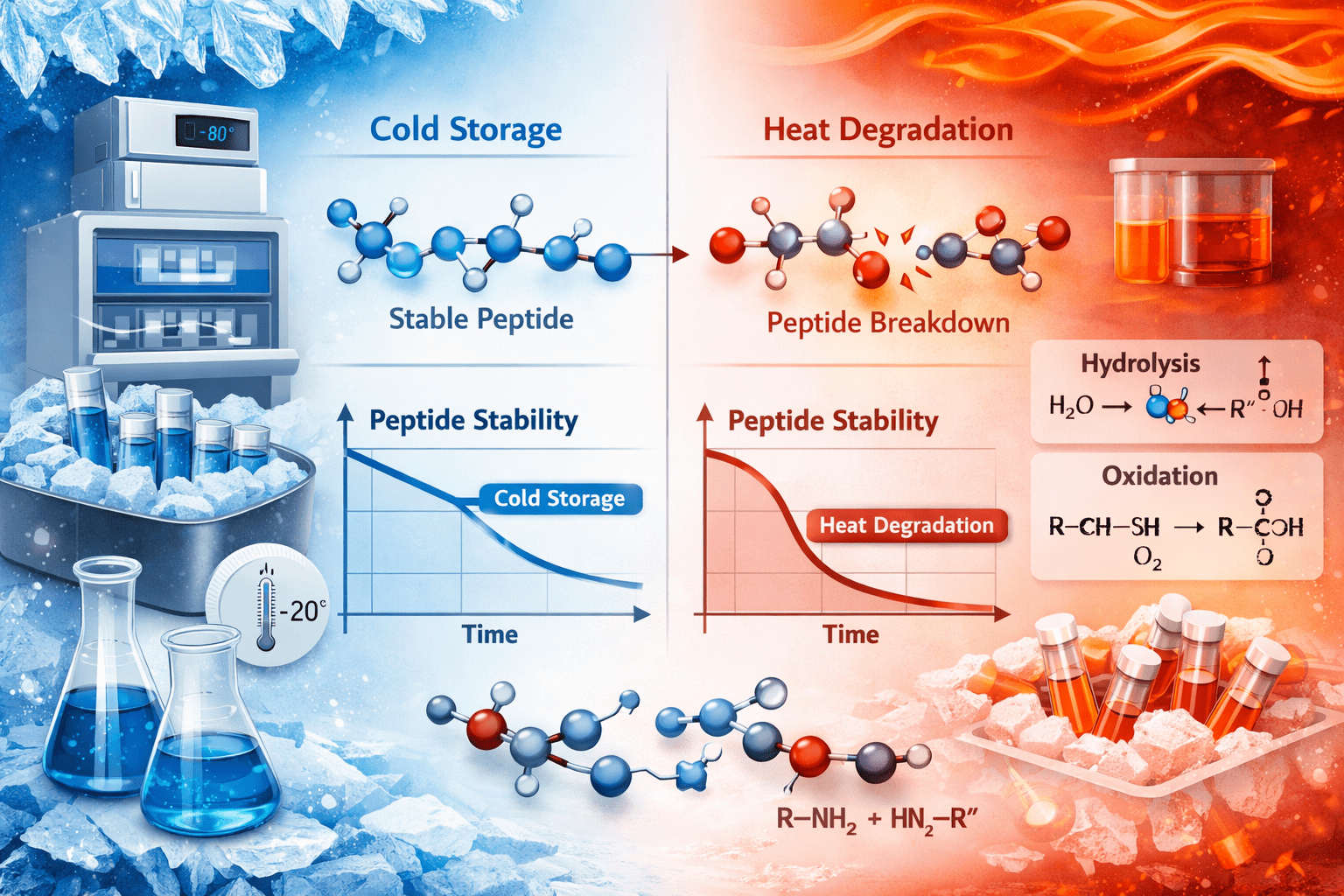
Peptide storage represents one of the most critical yet frequently misunderstood aspects of research peptide handling. Understanding degradation mechanisms, optimal storage conditions, and stability-preservation techniques is essential for maintaining research integrity and ensuring consistent results. Proper peptide storage not only preserves peptide activity but also maximizes research investments by preventing costly degradation. This comprehensive 2026 guide covers everything researchers need to know about peptide storage, from lyophilized powder handling to reconstituted solution stability.
Understanding Peptide Degradation and Storage
Peptides are inherently unstable molecules compared to small-molecule drugs. Their amino acid chains are susceptible to multiple degradation pathways that can compromise research outcomes. Effective peptide storage strategies address these degradation mechanisms to preserve peptide integrity.
Primary Degradation Mechanisms Affecting Peptide Storage:
Hydrolysis:
- Most common degradation pathway affecting peptide storage
- Water molecules attack peptide bonds
- pH-dependent (accelerated in acidic/basic conditions)
- Creates shorter peptide fragments
- Results in complete loss of biological activity
Oxidation:
- Affects methionine, cysteine, tryptophan, and tyrosine residues
- Initiated by oxygen, light, or metal ions
- Creates oxidized derivatives with altered activity
- Can cause aggregation and precipitation
- Major concern in peptide storage protocols
Deamidation:
- Asparagine and glutamine residues most vulnerable
- Converts to aspartic acid and glutamic acid
- Changes peptide charge and structure
- pH and temperature dependent
- Gradual process in peptide storage
Aggregation:
- Peptide molecules cluster together
- Forms insoluble precipitates
- Reduces bioavailability
- Can trigger immune responses in biological systems
- Common problem in improper peptide storage
Factors Affecting Peptide Storage Stability
Temperature:
The single most critical factor in peptide storage. Each 10°C increase in temperature approximately doubles degradation rates (Arrhenius principle).
- Room temperature (20-25°C): Rapid degradation (hours to days)
- Refrigeration (2-8°C): Moderate stability (days to weeks)
- Freezing (-20°C): Good stability (months to years)
- Deep freezing (-80°C): Excellent stability (years)
Proper peptide storage temperature control is non-negotiable for research quality.
pH:
Most peptides are stable between pH 4-7 during storage. Extreme pH accelerates hydrolysis:
- pH <3: Acid-catalyzed hydrolysis dominates
- pH 4-7: Optimal peptide storage zone
- pH >8: Base-catalyzed hydrolysis increases
Light Exposure:
UV and visible light catalyze oxidation reactions affecting peptide storage:
- Aromatic amino acids particularly vulnerable
- Generates free radicals
- Accelerates degradation by 5-10x
- Amber vials or foil wrapping essential for peptide storage
Oxygen:
Dissolved oxygen promotes oxidative degradation in peptide storage:
- Affects sulfur-containing amino acids first
- Creates disulfide bond disruption
- Lyophilization under nitrogen/argon helps
- Reconstitution introduces oxygen risk
Lyophilized (Freeze-Dried) Peptide Storage
Optimal Conditions for Lyophilized Peptide Storage:
- Temperature: -20°C or lower
- Container: Sealed vials with inert atmosphere
- Light protection: Amber vials or foil-wrapped
- Humidity: <5% relative humidity
- Stability: 24-36 months for most peptides
Why Lyophilization Enhances Peptide Storage:
Removing water eliminates the primary degradation pathway (hydrolysis). Freeze-dried peptides typically show 100-1000x greater stability than solutions, making lyophilized peptide storage the preferred long-term option.
Storage Best Practices for Lyophilized Peptides:
- Keep vials sealed until ready to use
- Minimize freeze-thaw cycles (ideally zero before reconstitution)
- Store away from light sources
- Use desiccant packets in storage containers
- Label with peptide name, purity, and date received
- Maintain detailed peptide storage logs
Reconstituted Peptide Storage
Once reconstituted, peptide storage becomes significantly more challenging:
Bacteriostatic Water vs Sterile Water for Peptide Storage:
Bacteriostatic Water (0.9% benzyl alcohol):
- Stability: 30-60 days refrigerated
- Prevents bacterial growth
- Allows multiple withdrawals
- Preferred for peptides used over weeks
- Suitable for: Most peptides, extended research protocols
Sterile Water:
- Stability: 7-14 days refrigerated
- No preservatives
- Must use quickly or risk contamination
- Preferred when benzyl alcohol contraindicated
- Suitable for: Short-term research, single-use protocols
Acetic Acid Solution (for specific peptide storage):
- Used for peptides prone to aggregation
- Creates slightly acidic environment (pH 4-5)
- Enhances stability of certain sequences
- Examples: Fragment 176-191, some GH peptides
Reconstituted Peptide Storage Guidelines:
Essential practices:
- Store at 2-8°C immediately after reconstitution
- Never freeze reconstituted peptides (causes precipitation)
- Protect from light (refrigerator drawer or foil wrap)
- Minimize air exposure (keep capped when not in use)
- Use sterile technique for every withdrawal
- Discard if cloudiness, precipitation, or color change occurs
Peptide-Specific Storage Data
Different peptides exhibit varying stability profiles requiring tailored peptide storage approaches:
High Stability Peptides (60+ days reconstituted storage):
- CJC-1295 (with DAC)
- BPC-157
- TB-500/TB-4
- Melanotan 2
Moderate Stability Peptides (30-45 days reconstituted storage):
- Ipamorelin
- GHRP-2, GHRP-6
- Sermorelin
- GHK-Cu
Lower Stability Peptides (14-30 days reconstituted storage):
- AOD9604
- Fragment 176-191
- Hexarelin
- PT-141
Very Short Stability (<14 days reconstituted storage):
- Modified GRF (1-29) without DAC
- Some acetate salt formulations
Understanding these peptide storage timelines prevents waste and ensures research quality.
Signs of Peptide Degradation During Storage
Visual indicators:
- Cloudiness or turbidity (aggregation)
- Precipitation or particles floating
- Color change (oxidation)
- Crystallization
Functional indicators:
- Reduced effects in research models
- Inconsistent results between batches
- Complete loss of activity
When degradation is suspected during peptide storage, discard the peptide immediately.
Freeze-Thaw Cycle Impact on Peptide Storage
Each freeze-thaw cycle progressively damages peptides in storage:
Effects:
- Ice crystal formation disrupts peptide structure
- Concentration gradients during freezing/thawing
- pH shifts during phase transitions
- Protein aggregation at ice-water interfaces
Research data on freeze-thaw in peptide storage:
- 1st freeze-thaw: ~5-10% activity loss
- 3rd freeze-thaw: ~20-30% activity loss
- 5th freeze-thaw: ~50%+ activity loss
Prevention strategies for peptide storage:
- Aliquot peptides before first freeze
- Thaw only what’s needed for immediate use
- Never refreeze reconstituted peptides
- For lyophilized powder, minimize exposure time when retrieving vials
Optimal Reconstitution Techniques for Peptide Storage
Step-by-step protocol:
- Preparation:
- Bring lyophilized vial to room temperature (10-15 minutes)
- Prepare sterile or bacteriostatic water
- Sterilize work surface and hands
- Reconstitution:
- Calculate required volume for desired concentration
- Draw solvent into sterile syringe
- Inject solvent slowly down the vial side (not directly on powder)
- Never shake—swirl gently or let dissolve naturally
- Allow 5-10 minutes for complete dissolution
- Storage:
- Refrigerate immediately at 2-8°C
- Label with peptide name, concentration, date, and expiration
- Protect from light
Concentration Considerations in Peptide Storage:
Lower concentrations generally degrade faster due to:
- Higher surface area to volume ratio
- Greater exposure to container surface
- Dilution effects on stabilizing excipients
Optimal concentrations for peptide storage: 1-5mg/mL for most peptides
Travel and Transport: Peptide Storage
Maintaining stability during transport requires specific peptide storage considerations:
Lyophilized peptides:
- Can tolerate room temperature for 24-48 hours
- Use insulated shipping with ice packs for longer
- Overnight shipping preferred
- Minimal stability impact if brief exposure
Reconstituted peptides:
- Require continuous refrigeration
- Use insulated containers with ice packs
- Travel duration should not exceed 4-6 hours
- Consider freeze-dried alternatives for extended travel
Container Material Effects on Peptide Storage
Glass vials (preferred for peptide storage):
- Minimal peptide adsorption
- No leaching of plasticizers
- Better for long-term storage
- Amber glass provides light protection
Plastic vials:
- Some peptides adsorb to plastic surfaces
- May leach plasticizers into solution
- Acceptable for short-term storage (<30 days)
- More economical
Syringes:
- Polypropylene or glass preferred
- Don’t store peptides in loaded syringes >24 hours
- Peptide can adsorb to syringe walls
- Use immediately after drawing
Common Peptide Storage Mistakes
Mistake #1: Freezing reconstituted peptides
- Causes irreversible aggregation and precipitation
- Complete loss of activity common
- Violates fundamental peptide storage principles
Mistake #2: Light exposure
- Storing on refrigerator shelf under light
- Clear vials without protection
- Can degrade peptides 5-10x faster
Mistake #3: Contamination
- Using non-sterile technique
- Multiple needle punctures without alcohol swabs
- Bacterial growth visible as cloudiness
Mistake #4: Temperature fluctuations
- Leaving peptides at room temperature between uses
- Storing in refrigerator door (warmest spot)
- Not using insulation during transport
Mistake #5: Improper reconstitution
- Shaking vials vigorously (causes foaming and denaturation)
- Using tap water instead of bacteriostatic/sterile water
- Incorrect pH of reconstitution solvent
Quality Testing for Peptide Storage Stability
Research facilities should consider:
HPLC analysis:
- Confirms peptide purity over time
- Detects degradation products
- Quantifies peptide concentration
- Gold standard for stability assessment in peptide storage
Mass spectrometry:
- Confirms molecular weight
- Identifies degradation pathways
- Detects modifications (oxidation, deamidation)
Visual inspection:
- Simplest method
- Check for clarity, color, particles
- Should be performed before each use
Bioassay:
- Functional testing in research models
- Confirms biological activity
- Detects degradation not visible by other methods
Extending Peptide Shelf Life Through Proper Storage
Excipient addition:
Some research protocols add stabilizers for enhanced peptide storage:
- Mannitol (bulking agent, protects during lyophilization)
- Trehalose (prevents aggregation)
- Glycerol (cryoprotectant)
- Note: Only add if research protocol allows and compatibility confirmed
pH optimization:
Adjusting reconstitution pH to peptide’s optimal range:
- Most stable at pH 4-7
- Use appropriate buffers if needed
- Consult peptide-specific data
Reducing oxidation in peptide storage:
- Use oxygen-free reconstitution solvents when possible
- Minimize headspace in vials
- Add antioxidants (ascorbic acid, methionine) only if protocol allows
Cost of Degradation: Why Peptide Storage Matters
Peptide degradation represents significant research waste:
Example scenario:
- 10mg peptide vial: $200
- Improper peptide storage degrades 50% over 30 days
- Effective cost: $400 per 10mg of active peptide
- Proper peptide storage maintains 90%+ activity
- Effective cost: $220 per 10mg of active peptide
Proper peptide storage saves 45% in this example.
Advanced Peptide Storage Considerations
Humidity Control:
Even lyophilized peptides can absorb atmospheric moisture:
- Store with silica gel desiccant packets
- Seal containers properly after each opening
- Monitor humidity in peptide storage areas
- Replace desiccants when saturated
Temperature Monitoring:
Research-grade peptide storage should include:
- Calibrated thermometers in freezers/refrigerators
- Temperature logging systems
- Alarm systems for temperature excursions
- Backup power for critical storage
Inventory Management for Peptide Storage:
Best practices for research facilities:
- First-in, first-out (FIFO) rotation
- Clear labeling with receipt and expiration dates
- Regular inventory audits
- Segregation of expired materials
- Documentation of storage conditions
Frequently Asked Questions: Peptide Storage
How long can peptides be stored at room temperature?
Lyophilized peptides can typically tolerate 24-48 hours at room temperature, though this should be minimized. Reconstituted peptides should never be left at room temperature for more than 30-60 minutes. Proper peptide storage requires refrigeration or freezing.
Can I refreeze peptides?
Never refreeze reconstituted peptides—this causes irreversible aggregation. Lyophilized peptides can withstand limited freeze-thaw cycles, but this should be avoided for optimal peptide storage.
What’s the best peptide storage temperature?
For lyophilized peptides: -20°C or lower. For reconstituted peptides: 2-8°C (refrigerated, never frozen). These temperatures provide optimal stability for most research peptides.
Conclusion
Peptide storage and proper handling represent critical factors in research quality and cost-effectiveness. Understanding degradation mechanisms—hydrolysis, oxidation, deamidation, and aggregation—allows researchers to implement protective peptide storage strategies that preserve peptide integrity throughout research protocols.
Key principles for 2026 peptide storage protocols:
- Store lyophilized peptides at -20°C or lower in sealed containers
- Refrigerate reconstituted peptides at 2-8°C (never freeze)
- Use bacteriostatic water for extended stability (30-60 days)
- Protect all peptides from light exposure with amber vials or foil
- Minimize freeze-thaw cycles to zero for lyophilized powder
- Employ sterile technique for all handling and reconstitution
- Monitor for visual signs of degradation before each use
- Label all vials with peptide name, dates, and concentrations
- Discard any peptide showing cloudiness, precipitation, or color change
Research Impact:
Proper peptide storage not only preserves research integrity but also maximizes the value of research investments. A $200 peptide vial improperly stored may lose 50% of its activity within weeks, effectively dou
