
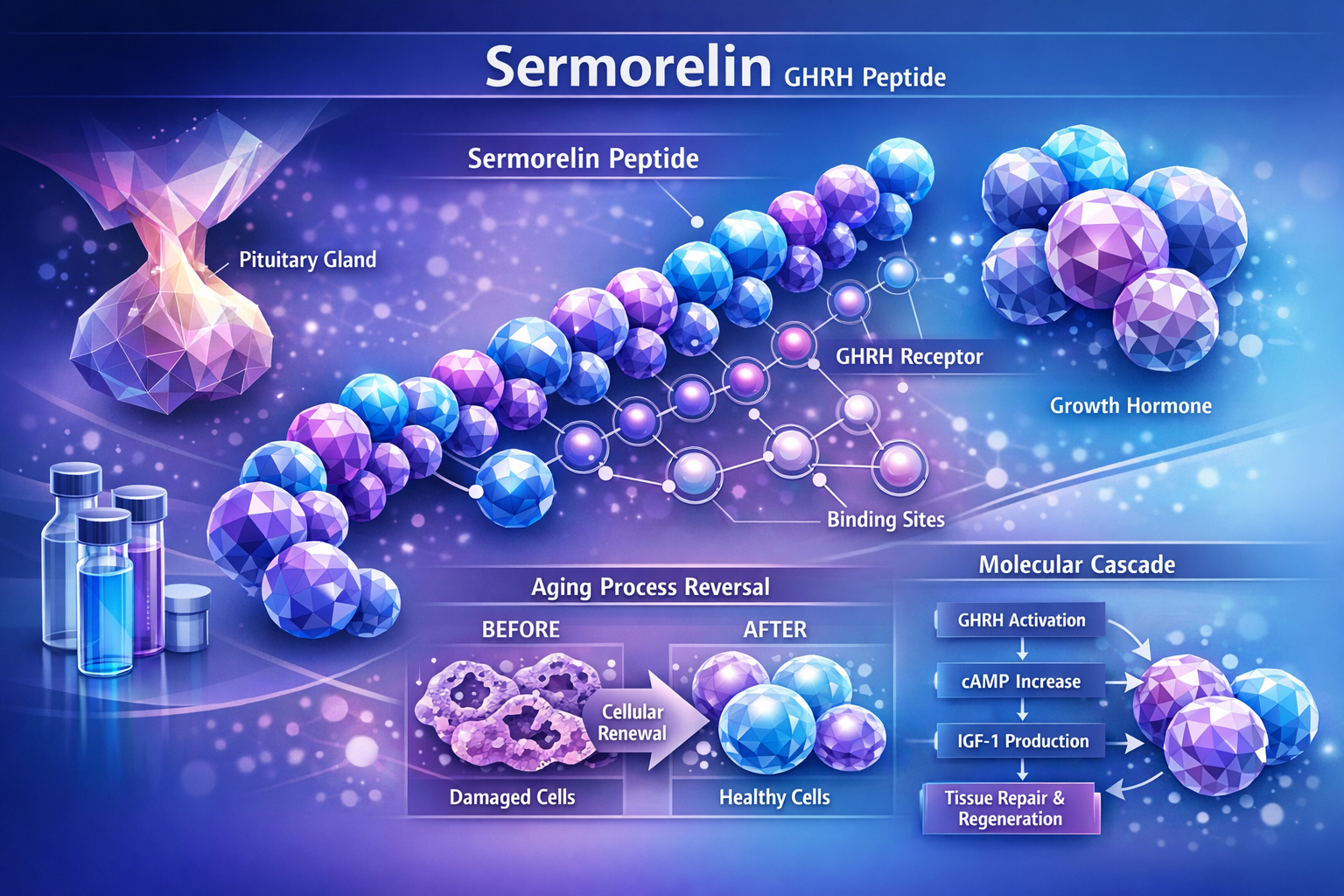
Sermorelin benefits for anti-aging research have positioned this growth hormone-releasing hormone (GHRH) analog as one of the most studied peptides in 2026. Research demonstrates natural growth hormone restoration through pituitary stimulation rather than direct hormone administration. Understanding how this peptide works—including GHRH receptor activation, age-related hormone optimization, and metabolic improvements—is essential for researchers exploring longevity and body composition protocols.
What Are Sermorelin Benefits for Research?
Sermorelin is a synthetic 29-amino acid peptide representing the active fragment of human growth hormone-releasing hormone (GHRH 1-44). Research into this compound began in the 1980s as scientists sought safer alternatives to direct GH administration. The profile centers on its ability to restore age-related declines in growth hormone production through natural pituitary stimulation.
The mechanism differs fundamentally from exogenous GH:
- Preserves natural pulsatile GH secretion patterns
- Maintains endogenous regulation and feedback loops
- Stimulates only physiological GH levels (no supraphysiological spikes)
- Works through the body’s natural GHRH receptors
- Cannot override natural regulatory mechanisms
Top 7 Sermorelin Benefits Supported by Research
Research demonstrates multiple advantages across diverse applications:
- Natural GH Production Restoration – Reverses age-related GH decline without exogenous hormone administration
- Improved Body Composition – Lean mass increases and fat mass reductions through natural GH optimization
- Enhanced Sleep Quality – Deeper slow-wave sleep and natural nocturnal GH pulse amplification
- Metabolic Health Improvement – Better insulin sensitivity and lipid profiles through GH-mediated effects
- Cognitive Function Support – Neuroprotective effects and improved mental clarity in research models
- Skin and Connective Tissue Benefits – Enhanced collagen production and tissue quality
- Cardiovascular Health Support – Improved endothelial function and cardiac performance markers
These effects occur through restoration of youthful GH patterns rather than pharmacological elevation, creating a favorable safety profile.
How Sermorelin Benefits Work: Primary Mechanisms
GHRH Receptor Activation:
The foundation involves binding to GHRH receptors on pituitary somatotroph cells. This receptor interaction triggers:
- Activation of adenylyl cyclase enzyme
- Increased cyclic AMP (cAMP) production
- Calcium ion influx into somatotroph cells
- Growth hormone synthesis and secretion
Unlike continuous GH elevation from exogenous administration, this approach maintains pulsatile patterns that preserve receptor sensitivity and natural regulation.
Age-Related GH Decline Reversal:
Research published in the Journal of Clinical Endocrinology and Metabolism demonstrates significant effects for age-related somatopause (declining GH production):
- GH secretion decreases ~14% per decade after age 30
- By age 60, GH production is ~50% of youthful levels
- Partial restoration of GH amplitude occurs
- Studies show 20-40% improvement in GH parameters
This ability to counteract natural GH decline without overriding physiological limits represents a key advantage for aging research.
IGF-1 Modulation:
Effects extend to insulin-like growth factor 1 (IGF-1) optimization:
- Gradual IGF-1 elevation over 2-4 weeks
- Peak levels reach 30-60% above baseline
- Physiological range maintenance (unlike GH injections)
- Coordinated GH-IGF-1 axis function
This gradual IGF-1 response represents a key benefit compared to immediate spikes from direct GH administration.
Circadian Rhythm Optimization:
Important advantages involve sleep architecture improvement:
- Enhanced slow-wave (deep) sleep duration
- Amplified nocturnal GH pulses
- Better sleep quality metrics
- Restored youthful sleep patterns
Research shows sleep improvements occur within 2-4 weeks of protocol initiation.
Sermorelin Benefits in Research Applications
Anti-Aging Research:
Significant interest in longevity research includes:
- Age-related GH deficiency studies
- Metabolic aging investigations
- Sarcopenia (muscle loss) research
- Frailty syndrome studies
- Quality of life assessments in aging models
Clinical research demonstrates improvements in multiple aging biomarkers simultaneously.
Body Composition Research:
Significant effects documented in body composition studies:
- Lean mass increases: 2-4kg over 6-12 months
- Fat mass reductions: 1-3kg over same period
- Visceral adipose tissue preferential reduction
- Preserved metabolic rate during aging
- Better muscle quality and strength markers
These effects occur without dietary intervention in controlled studies, though lifestyle factors amplify results.
Metabolic Health Research:
Important applications for metabolic syndrome investigation:
- Improved insulin sensitivity indices
- Better glucose disposal rates
- Enhanced lipid profiles (lower triglycerides, higher HDL)
- Reduced inflammation markers
- Better metabolic flexibility
Studies documented in PubMed show particular promise for age-related metabolic dysfunction.
Cognitive Function Research:
Emerging applications in neurological research:
- Neuroprotective effects in brain aging models
- Improved cognitive performance metrics
- Better memory consolidation during sleep
- Enhanced neuroplasticity markers
- Potential Alzheimer’s disease prevention applications
The cognitive health advantages likely involve both direct neural effects and improved sleep quality.
Cardiovascular Research:
Documented effects in cardiac studies:
- Improved cardiac output measurements
- Enhanced endothelial function
- Better exercise capacity
- Reduced cardiovascular risk markers
- Improved myocardial performance
Dosing Protocols: Maximizing Sermorelin Benefits
Standard Research Protocols:
- Dosage range: 200-500mcg per administration
- Frequency: Once daily, typically evening/bedtime
- Duration: 3-6 months for comprehensive assessment
- Route: Subcutaneous injection
- Timing: 30-60 minutes before sleep (optimal)
Age-Specific Protocols:
Ages 30-45 (Early Intervention):
- Dosage: 200-300mcg daily
- Focus: Prevention, performance optimization
- Expected effects: Enhanced recovery, body composition
Ages 45-60 (Moderate Decline):
- Dosage: 300-400mcg daily
- Focus: GH restoration, metabolic health
- Expected effects: Improved energy, body composition, sleep
Ages 60+ (Significant Decline):
- Dosage: 400-500mcg daily
- Focus: Age-related deficiency correction
- Expected effects: Comprehensive anti-aging improvements
Loading vs Maintenance:
Some research protocols employ loading phases:
- Loading: 500mcg daily for 4-8 weeks
- Maintenance: 200-300mcg daily ongoing
- Cycling: Some researchers cycle 5 days on, 2 days off
Sermorelin Benefits Timeline: What to Expect
Weeks 1-2:
Early observations:
- Improved sleep quality (first benefit noticed)
- Better sleep onset and duration
- More restorative sleep feeling
- Subtle energy improvements
Weeks 3-6:
Emerging effects:
- Noticeable body composition changes beginning
- Improved skin quality (hydration, elasticity)
- Enhanced recovery from exercise
- Better mood and mental clarity
- IGF-1 levels rising (measurable)
Weeks 8-12:
Established effects:
- Significant lean mass increases visible
- Fat loss becoming apparent
- Strength improvements measurable
- Metabolic markers improving
- Full sleep architecture optimization
Months 4-6:
Maximum effects:
- Peak body composition improvements
- Optimal metabolic health markers
- Maximum GH/IGF-1 optimization within physiological range
- Full spectrum of anti-aging advantages manifesting
Months 6+:
Sustained effects:
- Maintained improvements with continued use
- No tolerance development (unlike some peptides)
- Ongoing physiological optimization
- Long-term safety demonstrated
Comparison to Other GH Peptides
Sermorelin vs Ipamorelin:
- Sermorelin: Direct GHRH pathway, stronger GH secretion
- Ipamorelin: Ghrelin pathway, more selective (no cortisol/prolactin)
- Combination: Synergistic when used together
- Research use: Often combined for amplified effects
For detailed information on combination protocols, see our Ipamorelin and CJC-1295 guide.
Sermorelin vs CJC-1295:
- Sermorelin: Natural GHRH fragment, shorter half-life
- CJC-1295: Extended half-life (with DAC), less frequent dosing
- Sermorelin: More pulsatile, closer to natural physiology
- CJC-1295: More sustained elevation, convenience advantage
Sermorelin vs Direct GH:
- Sermorelin: Natural stimulation, preserved feedback loops
- Direct GH: Pharmacological levels, override natural regulation
- Sermorelin: Cannot overshoot physiological range
- Direct GH: Risk of supraphysiological levels
- Sermorelin: Superior long-term safety profile
- Direct GH: More powerful but higher risk
Safety Profile: Sermorelin Benefits Without Side Effects
One of the most significant advantages is the exceptional safety profile:
Minimal Side Effects Observed:
- Injection site reactions (mild, transient)
- Occasional headache (typically first week, resolves)
- Flushing or warmth sensation (rare, immediately post-injection)
- Transient water retention (mild, early phase)
- Increased appetite (actually desired in some research contexts)
No Observed Serious Adverse Effects:
Research demonstrates effects occur without:
- Tumor promotion or cancer risk
- Glucose intolerance or diabetes
- Edema or carpal tunnel syndrome (common with GH)
- Gynecomastia or hormonal disruption
- Organ enlargement
- Joint pain (common with direct GH)
Why Safety is Superior:
- Cannot override pituitary regulation
- Maintains natural negative feedback loops
- Works within physiological GH range
- Preserves pulsatile secretion patterns
- No supraphysiological hormone levels
Contraindications in Research Models:
- Active malignancy (theoretical concern, no evidence of promotion)
- Untreated hypothyroidism (may reduce response)
- Pregnancy/lactation (insufficient research data)
Monitoring in Research
Baseline Assessments:
Before initiating research protocols:
- IGF-1 levels (primary marker for GH activity)
- Complete metabolic panel
- Lipid profile
- Thyroid function (TSH, T3, T4)
- Body composition analysis (DEXA scan preferred)
- Sleep quality assessments
- Cognitive function baselines
Progress Monitoring:
- Week 4-6: Initial IGF-1 response, sleep improvements
- Week 12: Mid-protocol body composition, metabolic markers
- Week 24: Comprehensive assessment of all effects
- Ongoing: IGF-1 monitoring every 3-4 months
Biomarkers Tracking:
- IGF-1: Should increase 30-60% above baseline
- Body composition: DEXA or bioimpedance
- Metabolic: Glucose, insulin, lipids
- Inflammatory: CRP, IL-6 (should decrease)
- Cardiovascular: Blood pressure, endothelial function
Optimizing Results
Timing for Maximum Effects:
Research demonstrates optimal results with evening administration:
- 30-60 minutes before sleep (aligns with natural nocturnal GH pulse)
- Empty stomach (food blunts GH response)
- Consistent timing (establishes rhythm)
- Away from exercise (exercise triggers natural GH, may compete)
Lifestyle Factors Enhancing Effects:
- Sleep optimization: 7-9 hours quality sleep amplifies results
- Exercise: Resistance training synergizes with GH effects
- Nutrition: Adequate protein supports anabolic processes
- Stress management: Cortisol antagonizes GH effects
- Intermittent fasting: May enhance GH sensitivity
Contraindicated Factors Reducing Effects:
- Hyperglycemia: High blood sugar blunts GH response
- Excess body fat: Adiposity reduces GH secretion
- Chronic stress: Elevated cortisol antagonizes effects
- Poor sleep: Reduces natural GH optimization
- Alcohol: Disrupts sleep architecture and GH pulses
Reconstitution and Storage
For comprehensive peptide storage protocols, see our complete peptide storage guide.
Lyophilized Storage:
To maintain potency:
- Store at -20°C or colder
- Protect from light and moisture
- Stability: 24-36 months properly stored
- Sealed vials with desiccant
Reconstitution Protocol:
- Use bacteriostatic water (preferred for multi-dose)
- Typical concentration: 3mg per 3mL (1mg/mL)
- Inject slowly down vial wall
- Gentle swirling only (never shake)
- Allow complete dissolution
Post-Reconstitution Storage:
- Refrigerate at 2-8°C immediately
- Stability: 30-60 days with bacteriostatic water
- Never freeze once reconstituted
- Protect from light (amber vial or foil)
- Discard if cloudiness develops
Cost-Effectiveness
Typical Research Budget:
3-month protocol (300mcg daily):
- Total needed: ~27mg
- Approximate cost: $200-350
- Cost per day: $2.20-3.90
- Cost per month: $67-117
6-month protocol (300mcg daily):
- Total needed: ~54mg
- Approximate cost: $350-600
- Cost per day: $1.95-3.30
- Cost per month: $58-100
Compared to alternatives:
- Direct GH: $300-1000/month
- Sermorelin: $60-120/month
- Cost savings: 1/5 to 1/10 of direct GH
Combination Protocols
Sermorelin + Ipamorelin:
- Most popular combination for maximizing effects
- Sermorelin (GHRH pathway) + Ipamorelin (ghrelin pathway)
- Synergistic GH pulse amplification
- Enhanced response: 50-100% greater GH output
Sermorelin + GABA:
- GABA may enhance effects through HGH pathway support
- Taken together before sleep
- Anecdotal reports of improved sleep quality
- Research limited but promising
Lifestyle Synergies:
Maximize results through:
- Resistance training (3-5x weekly)
- Adequate protein intake (1.6-2.2g/kg)
- Quality sleep (7-9 hours)
- Stress management
- Intermittent fasting protocols
Frequently Asked Questions About Sermorelin Benefits
How does sermorelin compare to growth hormone?
Sermorelin stimulates natural pituitary GH production preserving feedback loops, while direct GH bypasses regulation. This peptide offers 60-70% of GH advantages with superior safety and lower cost.
Can women use sermorelin?
Yes, research shows comparable effects in both sexes. Women may experience enhanced advantages for skin quality, body composition, and bone density due to hormonal synergies.
Does sermorelin build muscle?
Research shows modest lean mass increases (2-4kg over 6 months) primarily through natural GH optimization. Effects are more subtle than anabolic steroids but safer long-term.
Are the effects permanent?
Continued administration is required for maintenance. Structural improvements (bone density, tissue quality) may persist longer than acute effects (enhanced GH pulses).
How long until results appear?
Initial improvements like better sleep appear within 1-2 weeks, while body composition changes manifest at 6-12
Conclusion
Sermorelin benefits represent a sophisticated approach to growth hormone optimization through natural pituitary stimulation. The comprehensive advantage profile—including body composition improvements, metabolic health enhancement, sleep optimization, and anti-aging effects—occurs through restoration of youthful GH patterns within physiological ranges.
The exceptional safety associated with sermorelin benefits allows for long-term research protocols without concerns accompanying direct GH use. Combined with cost-effectiveness and preservation of natural regulatory mechanisms, this positions the peptide as a cornerstone tool for researchers investigating aging, body composition, metabolic health, and growth hormone physiology.
As 2026 research continues expanding understanding of sermorelin benefits, this peptide remains essential for investigations into healthy aging and hormone optimization. The ability to restore age-related GH decline without overriding natural regulation makes these effects uniquely valuable for both research and future therapeutic applications.
