
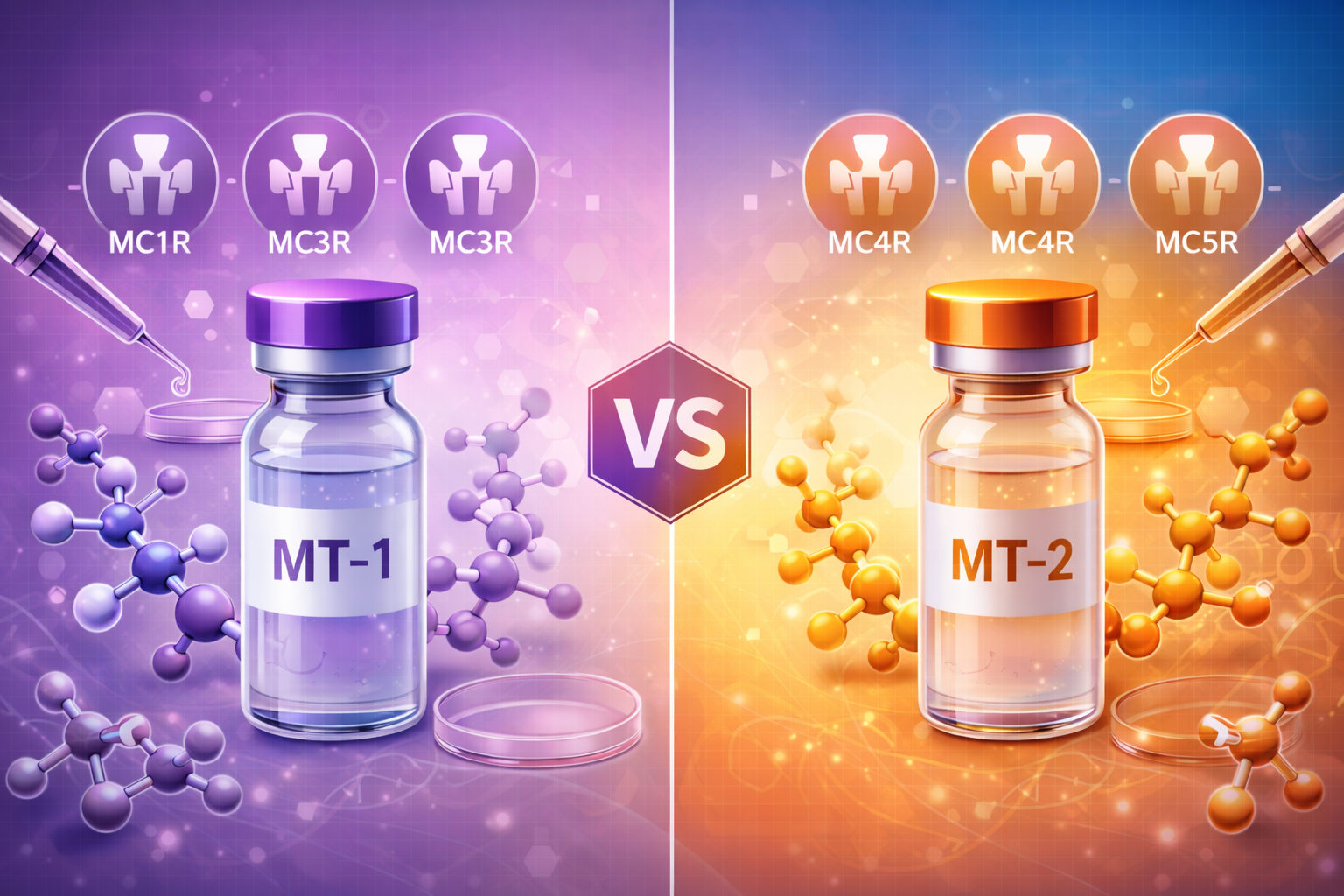
Melanotan 2 vs Melanotan 1 represents one of the most frequently misunderstood comparisons in peptide research. Understanding the structural differences, receptor selectivity, and distinct mechanisms between Melanotan 2 vs Melanotan 1 is essential for researchers working with melanocortin pathways. This comprehensive 2026 comparison guide explores how these two peptides differ in their biological activity, research applications, and safety profiles.
Structural Chemistry: Melanotan 2 vs Melanotan 1
The fundamental difference in Melanotan 2 vs Melanotan 1 begins with their molecular structures. Melanotan 1 (afamelanotide) is a linear 13-amino acid peptide analog of alpha-melanocyte-stimulating hormone (α-MSH). Melanotan 2 is a cyclic 7-amino acid analog with a lactam bridge structure that provides enhanced stability and altered receptor binding characteristics.
This structural difference fundamentally changes how each peptide interacts with melanocortin receptors throughout the body, making the Melanotan 2 vs Melanotan 1 comparison critical for research protocol design.
Receptor Selectivity: The Critical Difference in Melanotan 2 vs Melanotan 1
The melanocortin system includes five receptor subtypes (MC1R through MC5R), each with distinct tissue distribution and functions. Understanding receptor selectivity is the most important factor when comparing Melanotan 2 vs Melanotan 1.
Melanotan 1 Selectivity:
- Primary affinity: MC1R (melanocytes)
- Minimal activity: MC3R, MC4R, MC5R
- No significant MC2R activation
- Highly selective receptor profile
Melanotan 2 Selectivity:
- Broad spectrum binding: MC1R, MC3R, MC4R, MC5R
- Significant MC4R activation (appetite and sexual function pathways)
- Moderate MC3R activation (energy homeostasis)
- Non-selective receptor profile
Melanogenesis Mechanisms
Both peptides in the Melanotan 2 vs Melanotan 1 comparison stimulate melanin production, but through different efficiency patterns:
Melanotan 1 produces melanogenesis exclusively through MC1R activation in melanocytes. The process follows the traditional α-MSH pathway, activating adenylyl cyclase and increasing cAMP levels, which upregulates tyrosinase enzyme production—the rate-limiting step in melanin synthesis.
Melanotan 2 achieves melanogenesis through the same MC1R pathway but with approximately 1000-fold greater potency due to its enhanced receptor binding affinity and resistance to degradation. This represents a crucial distinction in the Melanotan 2 vs Melanotan 1 potency comparison.
Research Dosing Protocols 2026: Melanotan 2 vs Melanotan 1
Melanotan 1:
- Loading phase: 10-20mg daily for 10-20 days
- Maintenance: 10-20mg every 7-14 days
- Higher total dosage required due to lower potency
- Subcutaneous administration preferred
Melanotan 2:
- Loading phase: 0.5-1mg daily for 7-14 days
- Maintenance: 0.5-1mg weekly
- Significantly lower dosage requirements
- Subcutaneous administration standard
The dosing difference in Melanotan 2 vs Melanotan 1 protocols reflects the dramatic potency variation between these peptides.
Side Effect Profiles: Melanotan 2 vs Melanotan 1
The receptor selectivity differences create distinct side effect patterns in the Melanotan 2 vs Melanotan 1 comparison:
Melanotan 1:
- Minimal systemic effects due to MC1R selectivity
- Injection site reactions most common
- Mild nausea in approximately 10% of research subjects
- No appetite or libido effects
- Better tolerated in sensitive research models
Melanotan 2:
- MC4R activation causes appetite suppression
- Increased libido and spontaneous erections (male subjects)
- Nausea more prevalent (20-30% of subjects)
- Facial flushing common during initial administration
- Yawning and stretching reflexes noted
Clinical Research Applications
Melanotan 1 Research Focus:
- Photoprotection studies in photosensitive conditions
- Erythropoietic protoporphyria (EPP) research
- Dermatological protection research
- FDA-approved (afamelanotide) for specific indications
- Long-term safety profile established
Melanotan 2 Research Focus:
- Broader melanocortin system investigation
- Appetite regulation studies
- Sexual function research
- Body composition research
- Not FDA-approved for any indications
Pharmacokinetics Comparison: Melanotan 2 vs Melanotan 1
Melanotan 1:
- Half-life: Approximately 33 minutes
- Duration of effect: 48-72 hours post-injection
- Linear structure makes it more susceptible to enzymatic degradation
- Requires higher and more frequent dosing
Melanotan 2:
- Half-life: Approximately 1 hour
- Duration of effect: 72-96 hours post-injection
- Cyclic structure provides enzymatic resistance
- More efficient receptor binding and activation
The pharmacokinetic differences in Melanotan 2 vs Melanotan 1 significantly impact research protocol design and administration schedules.
Storage and Reconstitution
Both peptides in the Melanotan 2 vs Melanotan 1 comparison follow similar storage protocols:
- Lyophilized powder: -20°C for 24+ months
- Reconstituted: 2-8°C for up to 30 days
- Bacteriostatic water preferred for reconstitution
- Protect from light to prevent peptide degradation
- Single-use sterile vials recommended
Cost-Effectiveness in Research: Melanotan 2 vs Melanotan 1
Despite higher per-milligram costs, Melanotan 2 generally proves more cost-effective for research due to:
- 1000x greater potency requiring lower total amounts
- Less frequent administration requirements
- Smaller storage space requirements
- Reduced handling and preparation time
When conducting a Melanotan 2 vs Melanotan 1 budget analysis, total protocol costs typically favor Melanotan 2 despite higher unit prices.
Legal and Regulatory Status 2026
Melanotan 1 (as afamelanotide/Scenesse®) has FDA approval for erythropoietic protoporphyria treatment. Melanotan 2 remains investigational with no approved therapeutic uses. Both are available for legitimate research purposes through licensed chemical suppliers. This regulatory distinction is important when comparing Melanotan 2 vs Melanotan 1 for research applications.
Which Peptide for Which Research? Melanotan 2 vs Melanotan 1 Selection Guide
Choose Melanotan 1 when:
- MC1R-specific research is required
- Minimizing off-target effects is critical
- Long-term safety data is essential
- Regulatory-approved compound needed
- Photoprotection is the primary focus
Choose Melanotan 2 when:
- Broader melanocortin research is intended
- MC4R pathway investigation is relevant
- Lower dosing volumes preferred
- Cost efficiency is a consideration
- Multiple melanocortin effects are being studied
Melanotan 2 vs Melanotan 1: Potency Comparison
The most striking difference in the Melanotan 2 vs Melanotan 1 comparison is potency. Research demonstrates Melanotan 2 exhibits approximately 1000-fold greater binding affinity to MC1R receptors compared to Melanotan 1. This dramatic potency difference stems from:
- Cyclic structure providing conformational stability
- Enhanced receptor binding kinetics
- Resistance to peptidase degradation
- Optimized pharmacophore geometry
This potency advantage makes Melanotan 2 the preferred choice for research requiring lower dosing volumes and reduced injection frequency.
Melanocortin Receptor Distribution: Understanding Melanotan 2 vs Melanotan 1 Effects
MC1R (Melanocytes):
Both peptides activate MC1R, but Melanotan 2 does so with far greater efficiency. This receptor controls melanin production and is the primary target for photoprotection research.
MC3R (Energy Homeostasis):
Melanotan 2 shows significant MC3R activation, while Melanotan 1 has minimal activity. MC3R influences energy expenditure and is located in the hypothalamus and peripheral tissues.
MC4R (Appetite and Sexual Function):
The most significant difference in Melanotan 2 vs Melanotan 1 receptor selectivity occurs at MC4R. Melanotan 2’s strong MC4R activation produces appetite suppression and sexual function effects, while Melanotan 1 shows negligible MC4R activity.
MC5R (Sebaceous Glands):
Melanotan 2 activates MC5R affecting sebum production, while Melanotan 1 has minimal activity at this receptor.
Research Safety Considerations: Melanotan 2 vs Melanotan 1
Melanotan 1 Safety Profile:
- Extensive clinical trial data available
- FDA-approved formulation (Scenesse®)
- Minimal systemic side effects
- No cardiovascular concerns noted
- Safe for long-term research protocols
Melanotan 2 Safety Profile:
- Limited clinical trial data
- No regulatory approvals
- More frequent side effects due to broader receptor activation
- Cardiovascular monitoring recommended in certain research models
- Generally well-tolerated in short-to-medium term research
Reconstitution Protocols: Melanotan 2 vs Melanotan 1
Both peptides require careful reconstitution:
Step-by-step process:
- Bring vial to room temperature (10-15 minutes)
- Add bacteriostatic water slowly down vial side
- Swirl gently—never shake
- Allow 5-10 minutes for complete dissolution
- Refrigerate immediately at 2-8°C
- Protect from light
Typical concentrations:
- Melanotan 1: 10mg/mL (due to higher dosing requirements)
- Melanotan 2: 2-5mg/mL (lower doses needed)
Frequently Asked Questions: Melanotan 2 vs Melanotan 1
Which is more effective for melanogenesis research?
Melanotan 2 produces melanogenesis at 1000x lower doses compared to Melanotan 1, making it more efficient for research requiring minimal peptide quantities. However, Melanotan 1 offers MC1R-selective effects without off-target activity.
Can Melanotan 2 vs Melanotan 1 be used interchangeably?
No. The dramatic potency difference and distinct receptor selectivity profiles mean these peptides cannot be directly substituted. Protocols designed for one peptide require complete redesign for the other.
What are the stability differences in Melanotan 2 vs Melanotan 1?
Melanotan 2’s cyclic structure provides greater resistance to enzymatic degradation, offering slightly better stability in solution. Both peptides require refrigeration when reconstituted and freezing in lyophilized form.
Injection Protocols: Melanotan 2 vs Melanotan 1
Injection technique (both peptides):
- Route: Subcutaneous
- Needle: 29-31 gauge, 0.5 inch
- Sites: Abdomen, thighs, upper arms
- Rotation: Change sites with each injection
- Angle: 45-90 degrees depending on body composition
Timing differences:
- Melanotan 1: Typically administered daily during loading, then weekly
- Melanotan 2: Daily during loading (7-14 days), then 1-2x weekly maintenance
Future Research Directions: Melanotan 2 vs Melanotan 1
Emerging research areas exploring the Melanotan 2 vs Melanotan 1 comparison include:
- Selective MC4R antagonists to reduce Melanotan 2 side effects
- Modified Melanotan 1 analogs with enhanced potency
- Combination protocols leveraging strengths of both peptides
- Novel delivery systems (transdermal, oral formulations)
- Tissue-specific targeting mechanisms
Conclusion
The Melanotan 2 vs Melanotan 1 comparison reveals two distinct peptides with fundamentally different receptor selectivity profiles, potency levels, and research applications. While both share melanogenic properties through MC1R activation, their mechanistic differences make them suited for distinct research objectives.
Melanotan 1 offers highly selective MC1R research with established safety profiles and regulatory approval, making it ideal for photoprotection and dermatological research. Melanotan 2 provides broader melanocortin system investigation with 1000-fold greater potency, valuable for researchers studying MC3R, MC4R, and MC5R pathways alongside melanogenesis.
When designing research protocols, the Melanotan 2 vs Melanotan 1 decision should be based on receptor selectivity requirements, desired effects, safety considerations, and regulatory status needs. Both peptides should be sourced from verified USA manufacturers maintaining strict purity and quality standards to ensure reliable, reproducible research outcomes.
DISCLAIMER: FOR RESEARCH USE ONLY – NOT FOR HUMAN CONSUMPTION
This content is for educational and research purposes only. These products are sold strictly for in-vitro research and laboratory experimentation only. All information provided is for informational purposes and is not intended for diagnostic or medical use. Peptides described are not for human consumption. Vivo Peptides does not encourage or promote the use of any of these products in a manner contrary to the law.
