
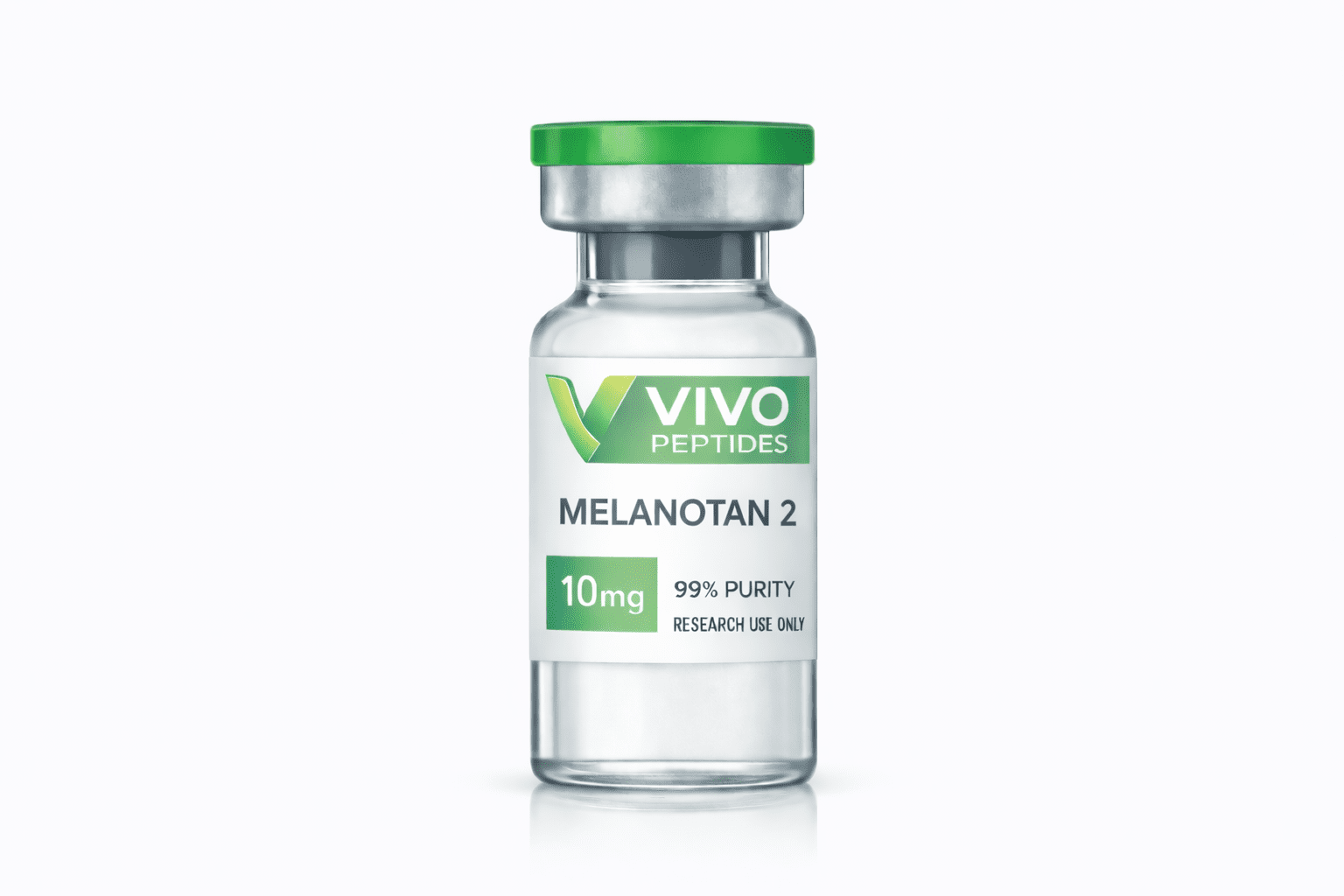
Melanotan 2
$50.00 (USD)
Melanotan 2 (MT-2) is a synthetic cyclic heptapeptide analogue of the endogenous alpha-melanocyte-stimulating hormone (α-MSH).
In research settings, it is widely utilized to investigate the melanocortin system’s role in regulating skin pigmentation (melanogenesis), sexual behavior, and energy homeostasis (appetite suppression) through non-selective activation of melanocortin receptors.
Note: This product is intended for research use only and is not for human consumption.
Melanotan 2 was originally developed to study the stimulation of melanin production without the need for ultraviolet (UV) radiation exposure. Research indicates that unlike its predecessor Melanotan I (Afamelanotide), MT-2 acts as a non-selective agonist with high affinity for MC1, MC3, MC4, and MC5 receptors.
This broad receptor binding profile allows researchers to explore multiple physiological pathways simultaneously: the activation of MC1R leads to increased melanogenesis (tanning), while binding to MC3R and MC4R in the central nervous system is linked to effects on sexual arousal and metabolic regulation (reduced food intake). Its cyclic lactam structure protects it from rapid enzymatic degradation, offering significantly higher potency and stability in experimental models compared to linear α-MSH.
Product Specifications:
-
Sequence: Ac-Nle-c[Asp-His-D-Phe-Arg-Trp-Lys]-NH2
-
Molecular Formula: C50H69N15O9
-
Molecular Weight: 1024.2 g/mol
-
CAS Number: 121062-08-6
-
Purity: ≥99% (HPLC)
-
Form: Lyophilized White Powder
Storage & Handling:
Lyophilized Melanotan 2 is stable at room temperature for short durations (up to 3 weeks) but should be stored desiccated below -18°C for long-term stability (1-2+ years). Upon reconstitution with bacteriostatic water, the solution must be stored at 4°C (refrigerated) and used within 30-60 days to prevent degradation and loss of potency.
Disclaimer:
All products listed on this website, including Melanotan 2, are for laboratory research purposes only. They are not intended for use as drugs, food additives, or cosmetic products. This product is not approved by the FDA for human use and should not be ingested or administered to humans or animals.
FAQ
What is the difference between Melanotan 2 and PT-141?
Melanotan 2 is the parent peptide from which PT-141 (Bremelanotide) was derived. While MT-2 activates the MC1 receptor (causing tanning) in addition to CNS receptors, PT-141 is a metabolite of MT-2 that lacks the C-terminal amide group responsible for strong MC1R binding. This makes PT-141 more specific for sexual function research without the tanning side effect.
Why is it called a “non-selective” agonist?
“Non-selective” means that Melanotan 2 binds to multiple types of melanocortin receptors (MC1, MC3, MC4, MC5) rather than just one. This is why research on MT-2 observes a wide range of effects, including pigmentation, appetite suppression, and libido enhancement, rather than a single isolated outcome.
Does Melanotan 2 require UV exposure in research?
While MT-2 stimulates melanin production independently, research suggests that the presence of UV light can potentiate the melanogenic process. However, the peptide itself is capable of upregulating the enzymatic machinery (tyrosinase) for pigmentation without direct UV radiation.
How long does the reconstituted peptide last?
Once mixed with bacteriostatic water, Melanotan 2 is reasonably stable if kept refrigerated (2-8°C). Standard laboratory protocols recommend using the reconstituted solution within 4-8 weeks to ensure data consistency, as peptides in solution slowly degrade over time.
Related Products
AOD9604 is a derivative of human growth hormone (hGH) and a modified version of the hGH fragment 176-191 peptide, incorporating a di-sulfide bridge. What’s exciting about this peptide is that it does not affect IGF-1 or insulin levels and is, therefore, not a risk in promoting glucose intolerance.
Buy Cagrilintide Online
Cagrilintide is a long-acting amylin analogue, currently at the forefront of peptide research due to its rather interesting potential beneficial effect in individuals with diabetes. But what’s so special about amylin? Well, amylin is another peptide hormone, co-secreted with insulin, which inhibits food intake, delays gastric emptying, and, most importantly, reduces blood glucose levels.
Back to cagrilintide… it was originally developed to improve on the initial amylin analogue called pramlintide. The problem with pramlintide is its short half-life and undesired side effects.
Cagrilintide was (and still is being) developed to alter the half-life, potency and stability of pramlintide, and other amylin analogues.Since, it’s still a relatively new peptide, it still needs to undergo further research so we can make sure its as effective and safe.
Cagrisema is a potent new blend, a combination that integrates two peptides – cagrilintide and semaglutide.
Semaglutide is a GLP-1 receptor agonist; a version of human GLP-1 hormone, modified to resist the degradation by the enzyme dipeptidyl peptidase-4.
Cagrilintdide, on the other hand, is an amylin analogue. Its role is to mimic the human hormone amylin and is structurally designed to be resistant to enzymatic degradation.
Together, these two peptides profoundly influence chemical structures and induce hormonal changes:
- Leading to the receptor changes within the pancreas and the brain
- Boosting insulin secretion
- Interacting with the receptors involved in appetite regulation
- Mimicking the action of amylin
- Decreasing glucagon secretion
All in all, this is a sophisticated, more importantly, incredibly potent combination of two peptides whose actions complement each other. Cagrisema combination influences some key hormonal processes and plays a role in metabolic regulation.
