
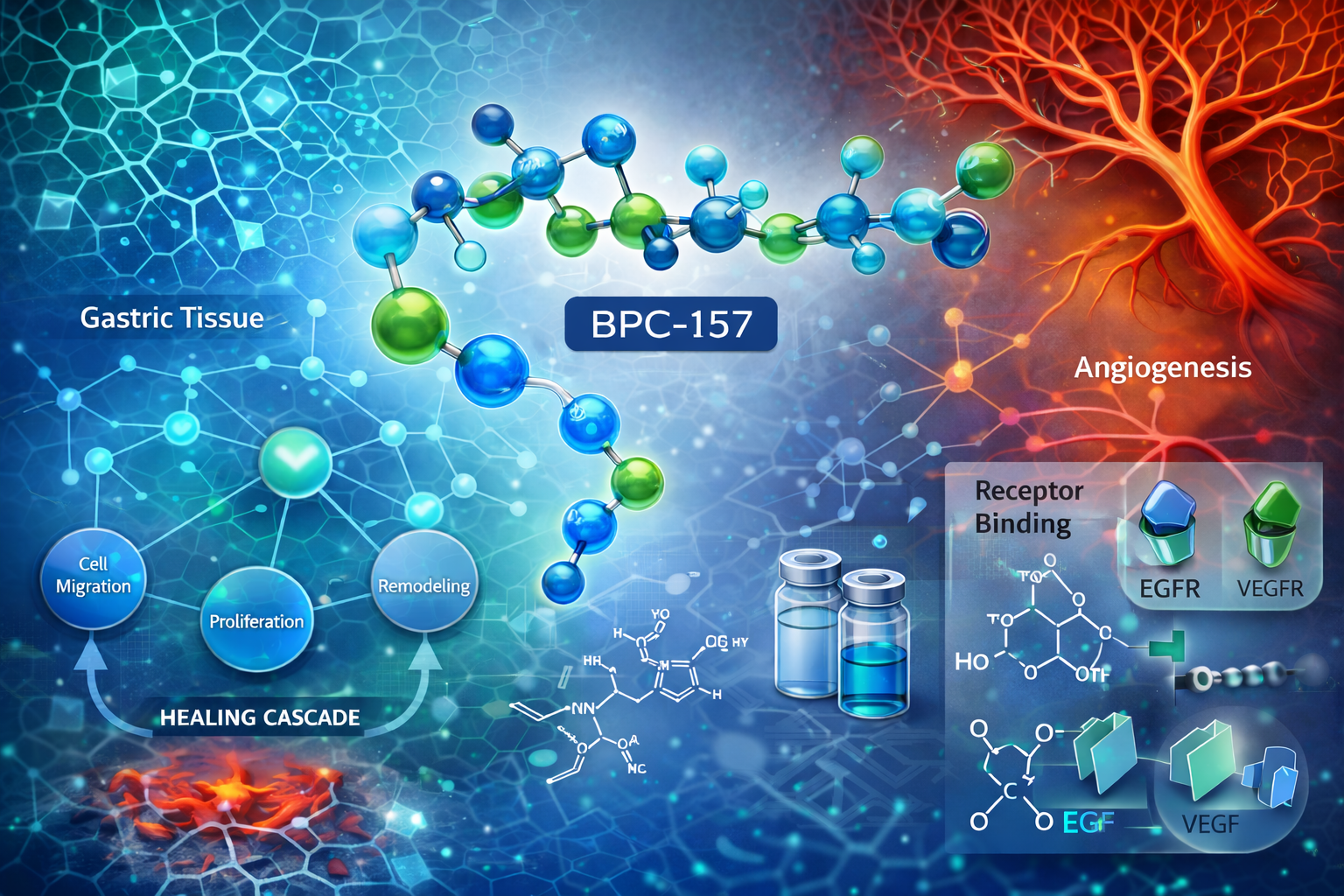
BPC 157 benefits have made this peptide one of the most extensively researched compounds for tissue repair and healing in 2026. Derived from body protection compound (BPC) found in gastric juice, this 15-amino acid peptide demonstrates remarkable regenerative properties across multiple tissue types. Understanding the mechanisms and applications of BPC 157 is essential for researchers exploring gastrointestinal protection, musculoskeletal healing, and regenerative medicine protocols.
What is BPC-157 and Its Benefits?
BPC-157 is a synthetic pentadecapeptide consisting of 15 amino acids. It represents a partial sequence of body protection compound (BPC) isolated from human gastric juice. Research into BPC 157 benefits began with investigations into gastric protection but has expanded to encompass tissue repair across multiple organ systems.
The BPC 157 benefits profile is unique among peptides due to its:
- Cytoprotective properties across multiple tissue types
- Angiogenic effects promoting blood vessel formation
- Anti-inflammatory mechanisms
- Growth factor modulation
- Remarkable safety profile with minimal side effects
How BPC 157 Benefits Work: Primary Mechanisms
Angiogenesis and Vascular Protection:
One of the most significant BPC 157 benefits involves promoting new blood vessel formation. Research demonstrates BPC 157 benefits include:
- VEGF (vascular endothelial growth factor) receptor modulation
- Enhanced endothelial cell migration and proliferation
- Improved vascular stability in injury models
- Blood flow restoration to ischemic tissues
Studies show BPC 157 benefits extend to both small and large vessel repair, making it valuable for cardiovascular and peripheral vascular research.
Gastrointestinal Protection:
The original BPC 157 benefits discovered involve gastric and intestinal protection:
- Prevention of NSAID-induced gastric ulcers
- Accelerated healing of existing gastric lesions
- Protection against inflammatory bowel conditions
- Maintenance of intestinal barrier integrity
- Reduction of intestinal inflammation
Research demonstrates BPC 157 benefits for GI protection occur through multiple pathways including nitric oxide regulation and growth factor modulation.
Musculoskeletal Healing:
Emerging BPC 157 benefits research focuses on connective tissue repair:
- Accelerated tendon healing in injury models
- Enhanced ligament repair processes
- Improved muscle regeneration after damage
- Bone healing support
- Reduced scar tissue formation
Studies document BPC 157 benefits reducing healing time by 30-50% in standardized tendon injury models.
Neuroprotective Properties:
Recent research reveals BPC 157 benefits extending to neural tissues:
- Protection against excitotoxic damage
- Enhanced dopaminergic and serotonergic system stability
- Traumatic brain injury mitigation
- Peripheral nerve regeneration support
Anti-Inflammatory Effects:
Significant BPC 157 benefits involve inflammation modulation:
- Downregulation of pro-inflammatory cytokines
- Reduction of excessive neutrophil infiltration
- Balanced inflammatory response supporting healing
- Protection against inflammation-induced tissue damage
Research Applications: BPC 157 Benefits
Gastrointestinal Research:
BPC 157 benefits are extensively studied in GI models:
- Ulcer healing and prevention studies
- Inflammatory bowel disease research
- Intestinal anastomosis healing
- Fistula closure investigations
- Gastric lesion protection
Research shows BPC 157 benefits producing 40-60% faster healing rates in gastric ulcer models compared to controls.
Orthopedic and Sports Medicine Research:
BPC 157 benefits attract significant interest in musculoskeletal research:
- Tendinopathy healing studies
- Ligament repair investigations
- Muscle strain recovery research
- Joint health and cartilage protection
- Post-surgical healing enhancement
Cardiovascular Research:
Emerging BPC 157 benefits research explores cardiac applications:
- Myocardial infarction damage reduction
- Arrhythmia prevention studies
- Blood vessel repair and angiogenesis
- Hypertensive damage protection
- Endothelial dysfunction improvement
Neurological Research:
BPC 157 benefits are being investigated in neural injury models:
- Traumatic brain injury research
- Spinal cord injury studies
- Peripheral neuropathy investigations
- Neurotoxicity protection research
Dosing Protocols: BPC 157 Benefits Research
Standard Research Protocols:
- Dosage range: 200-500mcg per administration
- Frequency: Once or twice daily
- Duration: 4-12 weeks typical research periods
- Route: Subcutaneous or intramuscular injection
- Some research explores oral administration
Injury-Specific Protocols:
Research exploring BPC 157 benefits for specific injuries often employs:
- Acute injury: 500mcg twice daily for 2-4 weeks
- Chronic injury: 250-500mcg once daily for 8-12 weeks
- Gastrointestinal: 200-400mcg twice daily
- Systemic healing: 250-500mcg once daily
Site-Specific vs Systemic Administration:
Debate exists regarding BPC 157 benefits administration:
- Near-site injection: Potentially enhanced local effects
- Systemic injection: Comparable benefits in most research
- Research suggests both approaches deliver BPC 157 benefits effectively
BPC 157 Benefits: Mechanism Deep Dive
VEGF Receptor Interaction:
BPC 157 benefits involve complex VEGF pathway modulation. Unlike direct VEGF administration, BPC-157 appears to regulate VEGF receptors, producing angiogenic BPC 157 benefits without overstimulation risks.
Nitric Oxide Pathway:
Significant BPC 157 benefits occur through NO (nitric oxide) system regulation:
- Enhanced eNOS (endothelial nitric oxide synthase) activity
- Balanced NO production supporting vascular health
- Protection against NO-related oxidative damage
- Improved blood flow and tissue oxygenation
Growth Factor Modulation:
BPC 157 benefits extend to multiple growth factor systems:
- Fibroblast growth factor (FGF) regulation
- Epidermal growth factor (EGF) pathway interaction
- Nerve growth factor (NGF) enhancement
- Coordinated growth factor response supporting tissue repair
FAK-paxillin Pathway:
Research reveals BPC 157 benefits involve focal adhesion kinase (FAK) and paxillin signaling:
- Enhanced cell migration and spreading
- Improved cytoskeletal organization
- Faster wound closure rates
- Better tissue integration during healing
Safety Profile: BPC 157 Benefits Without Side Effects
One of the most remarkable BPC 157 benefits is its exceptional safety profile:
Minimal Side Effects Observed:
- No significant hormonal disruption
- No immune system suppression
- No organ toxicity in long-term studies
- Rare injection site reactions
- No documented drug interactions
No Observed Adverse Effects:
Research demonstrates BPC 157 benefits occur without:
- Tumor promotion or cancer risk
- Cardiovascular complications
- Metabolic disturbances
- Neurological side effects
- Reproductive system impacts
This safety profile makes BPC 157 benefits accessible for long-term research protocols.
Comparative Research: BPC 157 Benefits vs Other Peptides
BPC-157 vs TB-4:
- BPC 157 benefits: Superior GI protection, tendon healing focus
- TB-4: Broader angiogenic effects, actin sequestration
- BPC 157 benefits: More cost-effective
- Both: Complementary in combination protocols
BPC-157 vs Growth Hormone Peptides:
- BPC 157 benefits: Direct tissue repair without hormonal effects
- GH peptides: Systemic anabolic environment, IGF-1 elevation
- BPC 157 benefits: Safer long-term profile
- Often combined for synergistic effects
Stability and Storage: Preserving BPC 157 Benefits
Lyophilized Storage:
To maintain BPC 157 benefits:
- Store at -20°C
- Protect from light and moisture
- Stability: 24+ months when properly stored
- Sealed vials with desiccant
Reconstituted Storage:
Preserving BPC 157 benefits after reconstitution:
- Refrigerate at 2-8°C
- Use bacteriostatic water for 30-60 day stability
- Never freeze once reconstituted
- Protect from light
- Discard if cloudiness develops
Reconstitution Methods:
Optimal technique for maintaining BPC 157 benefits:
- Use bacteriostatic water (preferred) or sterile water
- Inject slowly down vial side
- Swirl gently—never shake
- Allow complete dissolution
- Typical concentration: 2-5mg/mL
Clinical Trial Progress: BPC 157 Benefits
Current Clinical Research:
Several trials investigating BPC 157 benefits are underway:
- Inflammatory bowel disease studies
- Tendon injury healing trials
- Post-surgical healing enhancement
- Gastric ulcer treatment research
Regulatory Status:
BPC 157 benefits research occurs in investigational context:
- No FDA approval for therapeutic use
- Available for research purposes
- Multiple ongoing clinical trials
- Promising preliminary data
Combination Protocols: Enhancing BPC 157 Benefits
BPC-157 + TB-500:
Popular combination amplifying tissue repair benefits:
- Complementary healing mechanisms
- BPC 157 benefits + TB-4 angiogenesis
- Enhanced connective tissue repair
- Synergistic anti-inflammatory effects
BPC-157 + Growth Hormone Peptides:
Combining BPC 157 benefits with anabolic environment:
- BPC-157: Direct tissue repair
- GH peptides: Systemic anabolic support
- Improved body composition outcomes
- Enhanced recovery metrics
BPC-157 + Collagen Peptides:
Research exploring structural support:
- BPC 157 benefits promoting healing environment
- Collagen providing structural building blocks
- Improved connective tissue quality
- Better long-term healing outcomes
Administration Routes: Maximizing BPC 157 Benefits
Subcutaneous Injection:
Most common method for BPC 157 benefits research:
- Sites: Abdomen, thighs, upper arms
- Needle: 29-31 gauge, 0.5 inch
- Absorption: Reliable and consistent
- Technique: Simple and well-tolerated
Intramuscular Injection:
Alternative for BPC 157 benefits delivery:
- Sites: Deltoid, vastus lateralis, gluteus
- Needle: 23-25 gauge, 1-1.5 inch
- Absorption: Potentially faster
- Used for acute injury protocols
Oral Administration:
Emerging research on oral BPC 157 benefits:
- Gastric protection: Direct topical effect
- Systemic absorption: Under investigation
- Bioavailability: Lower than injection
- Convenience: Higher for GI-focused research
Research shows injectable routes deliver more consistent BPC 157 benefits for systemic and musculoskeletal applications.
Cost-Effectiveness: BPC 157 Benefits Per Dollar
Typical Research Budget:
12-week protocol (500mcg daily):
- Total BPC-157 needed: ~42mg
- Approximate cost: $200-350
- Cost per day: $2-3
24-week protocol (250mcg daily):
- Total BPC-157 needed: ~42mg
- Approximate cost: $200-350
- Cost per day: $1-1.50
BPC 157 benefits represent excellent value considering the breadth of applications and high safety profile.
Injury-Specific BPC 157 Benefits
Tendon Injuries:
Research demonstrates specific BPC 157 benefits:
- Achilles tendon: 40-50% faster healing
- Rotator cuff: Improved structural integrity
- Patellar tendon: Reduced inflammation
- Tennis elbow: Enhanced recovery rates
Muscle Injuries:
BPC 157 benefits in muscle damage models:
- Strain injuries: Faster functional recovery
- Contusions: Reduced hematoma formation
- Surgical damage: Enhanced post-op healing
- Chronic conditions: Improved tissue quality
Gastric Conditions:
Original BPC 157 benefits focus:
- NSAID ulcers: 60-70% healing improvement
- H. pylori damage: Enhanced mucosal protection
- IBD: Reduced inflammatory markers
- Fistulas: Accelerated closure rates
Monitoring BPC 157 Benefits in Research
Recommended Assessments:
Baseline measurements:
- Inflammatory markers (CRP, IL-6, TNF-α)
- Tissue imaging (ultrasound, MRI for structural studies)
- Functional assessments
- Pain/symptom scales in applicable models
Progress monitoring:
- Week 2-4: Initial response evaluation
- Week 6-8: Mid-protocol assessment
- Week 12+: Final outcomes
- Follow-up: Long-term benefit sustainability
Frequently Asked Questions: BPC 157 Benefits
How quickly do BPC 157 benefits appear?
Research shows initial BPC 157 benefits often observable within 7-14 days, with maximum effects typically at 4-8 weeks depending on injury type and severity.
Are BPC 157 benefits permanent?
Studies suggest improved tissue quality persists after protocol completion, though acute anti-inflammatory BPC 157 benefits may diminish. Structural healing improvements appear durable.
Can BPC 157 benefits help chronic injuries?
Research demonstrates BPC 157 benefits in both acute and chronic injury models. Chronic conditions may require longer protocols (12+ weeks) but show significant improvements.
Do BPC 157 benefits require cycling?
Unlike hormonal peptides, research suggests BPC 157 benefits don’t require cycling. Continuous use appears safe and effective in long-term studies.
Future Research Directions: BPC 157 Benefits
Emerging Areas:
- Combination with stem cell therapies
- Novel delivery systems (transdermal, sustained release)
- Modified analogs with enhanced stability
- Tissue-specific targeting mechanisms
- Oral formulations for systemic delivery
Potential Applications:
- Traumatic brain injury protocols
- Spinal cord injury research
- Organ transplant protection
- Radiation damage mitigation
- Age-related tissue degeneration
Conclusion
BPC 157 benefits represent a remarkable breadth of therapeutic potential spanning gastrointestinal protection, musculoskeletal healing, cardiovascular support, and neuroprotection. The mechanisms behind BPC 157 benefits—angiogenesis promotion, growth factor modulation, anti-inflammatory effects, and cytoprotection—make this peptide uniquely valuable for regenerative medicine research.
The exceptional safety profile associated with BPC 157 benefits allows for long-term research protocols without the concerns accompanying many other therapeutic compounds. Combined with cost-effectiveness and ease of administration, BPC 157 benefits position this peptide as a cornerstone tool for researchers investigating tissue repair and healing processes.
As 2026 research continues expanding our understanding of BPC 157 benefits, this peptide remains essential for investigations into wound healing, injury recovery, gastrointestinal protection, and regenerative medicine.
