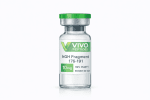
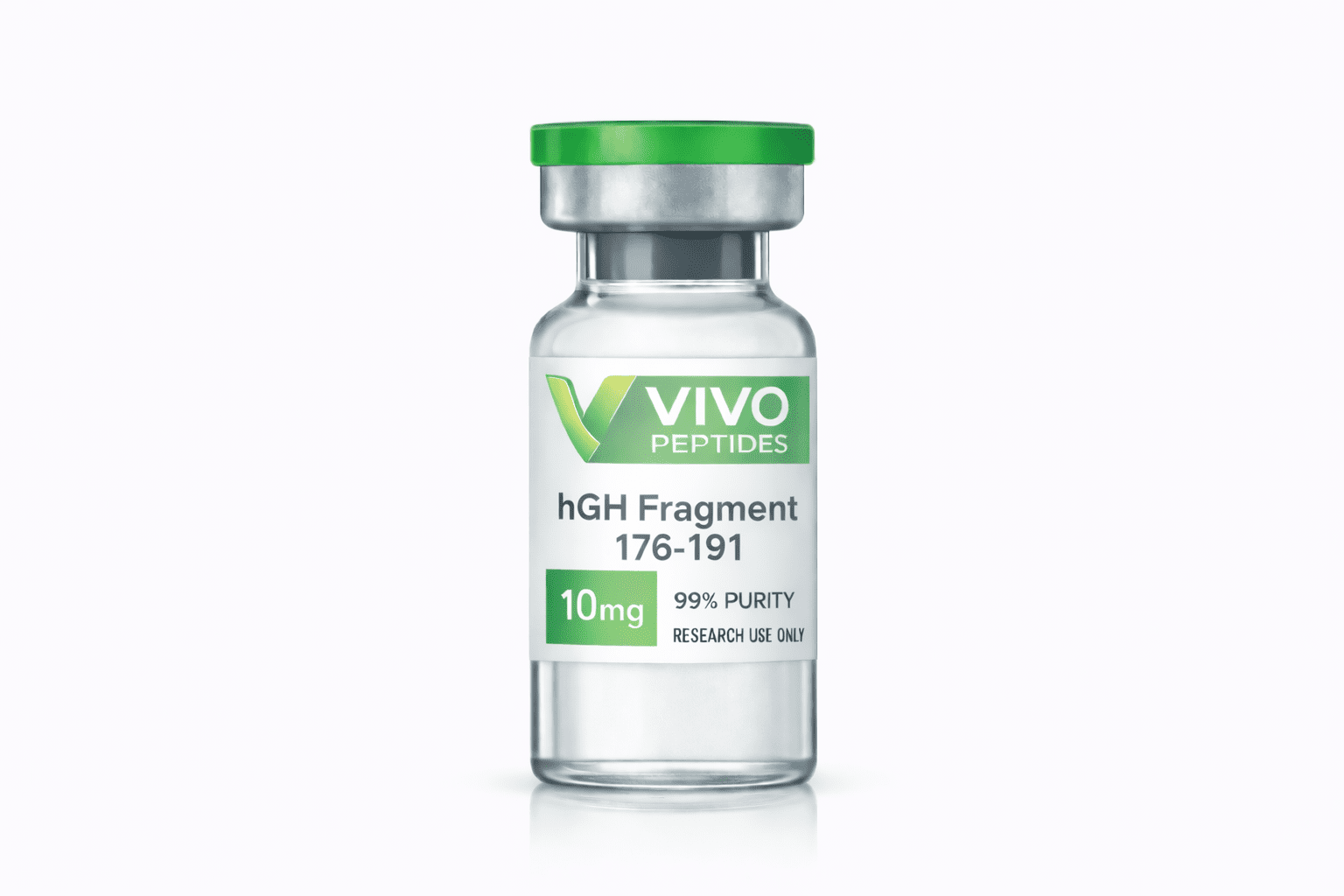
hGH Fragment 176-191

$80.00

  Hurry up! Sale end in:
Secured Payment Mastercard Visa
  ... people are viewing this right now

The hGH Fragment 176-191 is a stabilized analogue of the lipolytic factor of growth hormone. Scientific literature indicates that while the intact hGH molecule (191 amino acids) exerts a wide range of effects including cell proliferation and insulin signaling, the specific region spanning residues 176-191 is primarily responsible for the hormone’s fat-reducing properties.

Research studies have focused on this peptide’s ability to mimic the regulation of fat metabolism by interacting with beta-3 adrenergic receptors, thereby stimulating the breakdown of adipose tissue (lipolysis) and inhibiting the formation of fatty acids (lipogenesis). Unlike full-length hGH, Fragment 176-191 does not appear to compete for the hGH receptor involved in IGF-1 secretion, making it a critical tool for researchers aiming to isolate metabolic effects from anabolic growth functions.

Product Specifications:

  • Sequence: Tyr-Leu-Arg-Ile-Val-Gln-Cys-Arg-Sve-Gly-Ser-Cys-Gly-Phe (Note: Sequence variations exist depending on modification, typically Tyr-LRIV…)​

  • Molecular Formula: C78H125N23O23S2 (Approximate, varies by specific salt/form)

  • Molecular Weight: ~1817.1 g/mol

  • CAS Number: 66004-57-7 (general for fragments, varies)

  • Purity: ≥99% (HPLC)

  • Form: Lyophilized White Powder

Storage & Handling:
Lyophilized hGH Fragment 176-191 is stable at room temperature for short durations (up to 3 weeks) but should be stored desiccated below -18°C for long-term stability. Upon reconstitution, the peptide is highly sensitive; it should be stored at 4°C and used within 1-2 weeks. It is recommended to avoid repeated freeze-thaw cycles to prevent peptide degradation.

Disclaimer:
All products listed on this website, including hGH Fragment 176-191, are for laboratory research purposes only. They are not intended for use as drugs, food additives, or cosmetic products. This product is not approved by the FDA for human use and should not be ingested or administered to humans or animals.


FAQ

What is the difference between hGH Fragment 176-191 and AOD9604?
Both peptides are derived from the same C-terminal region of hGH and share similar lipolytic properties in research. However, AOD9604 is a modified version of Fragment 176-191 (often with a tyrosine modification at the C-terminus) designed to have a longer half-life and greater stability in biological systems compared to the standard Fragment 176-191.

Does this peptide affect blood sugar levels like regular HGH?
Preclinical studies suggest that Fragment 176-191 does not negatively impact insulin sensitivity or blood glucose levels, unlike the full hGH molecule which can induce hyperglycemia. This makes it a distinct subject of study for metabolic regulation.

Is this product suitable for muscle growth research?
Fragment 176-191 is specifically isolated for its metabolic (fat-burning) properties. It lacks the domain of the hGH molecule responsible for binding to receptors that stimulate IGF-1 release and subsequent muscle hypertrophy (growth). Therefore, it is not typically used as a primary agent in muscle growth research models.

How is the peptide supplied?
It is supplied as a lyophilized (freeze-dried) powder in a sterile vial, requiring reconstitution with a suitable solvent (such as Bacteriostatic Water) before use in laboratory experiments.​

My Cart
Recently Viewed
Categories
hGH Fragment 176-191

hGH Fragment 176-191

$80.00

Request a Call Back